On This Day …

Thursday, 25th August, 1853

Sir Henry Fox Young, governor of South Australia, offered a reward in 1851 for the first boat owner to navigate the Murray River to the Darling River Junction. He wanted to see trade routes open up using this great inland river. The first two boats would be up for £2000 each if they met the conditions.

On 25th August, 1853, Captain Francis Cadell launched his paddlesteamer, the Lady Augusta, from Goolwa (south of Adelaide) to complete this journey. His was not the first paddlesteamer on the river, however, and he soon found himself in a race against Captain William Randell on the Mary Ann. Although the Mary Ann was a smaller boat, the two raced neck and neck most of the way.

The Lady Augusta finally sailed ahead and reached Swan Hill first, on 17th September, hours ahead of the Mary Ann. They enjoyed some celebrations before heading on their way, Lady Augusta returning to Goolwa with a load of wool, and Mary Ann continuing on to Echuca before returning. And so the age of the paddlesteamers began.

Have you ever been to Mildura or Echuca and taken a ride on one of these old cruisers? How would you describe it?

Published in: on 24th August, 2012 at 10:29 am  Comments (4)  
Tags: , ,

On This Day …

Friday 18th August, 1876

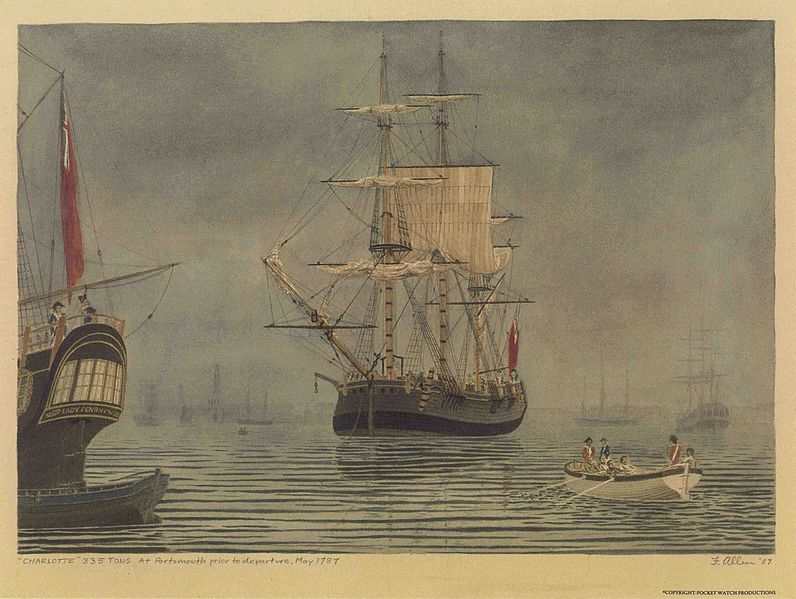
“CHARLOTTE” 335 TONS. At Portsmouth prior to departure, May 1787. Frank Allen

One decision on this day in 1876, changed, or rather began, a whole nation’s history. Today is the day the decision was made in England to begin a colony in Australia, a penal colony. The British prisons were overflowing, and even the prison hulks in the bays were full to capacity. America had declared her independence, so the colonies there were not an option. Something needed to be done.

Sixteen years earlier, Captain Cook had claimed the east coast of Australia for England — New South Wales — and declared it to be habitable. This new land seemed a good choice for the over-abundance of criminals in England.

I wonder what it was like for Captain — soon to be Governor — Arthur Phillip as he departed familiar lands for an uninhabited (in their eyes) country. Was it a daunting thing having the lives of over 700 convicts and almost as many military, crew and civilians under his care? Did he worry they would not survive? What a huge undertaking to set up a new colony, with no easy or quick way to obtain extra supplies. Home would be eight months away by sea.

The new colony did struggle to survive for a number of years, but survive she did. And now look at us. A whole nation, grown from very humble beginnings.

It is amazing how one decision, changes history so dramatically. The same happens with our lives. Have you ever made a decision that changed the course of your life in a major way?

Published in: on 17th August, 2012 at 10:38 am  Leave a Comment  
Tags: , ,

On This Day …

Monday, 10th August, 1874

Herbert Hoover. Taken in Perth, 1898.

This was the day that Herbert Hoover, 31st President of the United States, was born. But, did you know he spent several years of his early career in Australia? That’s right. He first came to Australia in 1897, employed as a mining engineer with Bewick, Moreing & Co. in the Western Australian gold fields.

He must have been good at what he did, because by the age of twenty-three, he was the mine manager. Typical as Aussies do, they nicknamed him H.C., or ‘Hail Columbia.’

Herbert Hoover married in 1899 and spent some time working for the coal mines in China, before returning to Australia once again. Back in the southern land, he became a partner in Bewick, Moreing & Co., but he did not remain here. Instead, he visited every few years, investing in the mines. He founded what became the Rio Tinto Group, to mine the zinc at Broken Hill.

Hoover obviously had a knack for business and made millions through his mining investments, and all before becoming President in 1929. Although he thought our country a land of ‘black flies, red dust and white heat,’ he still managed to find one of our most valuable commodities.

Hail Columbia is such an odd nickname. What is the most unusual nickname you’ve heard?

Published in: on 10th August, 2012 at 10:27 am  Comments (4)  
Tags: , ,

On This Day …

Sunday, 4th August, 1929

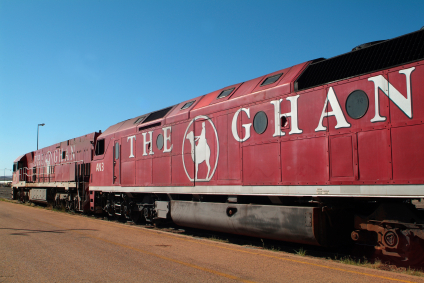
Central Australia and the Northern Territory are my favourite parts of this country. But, even when I was growing up the road north from Adelaide was rough. I remember my Dad driving on the side of the road in our 4WD, because the off-road experience was smoother than the corrugated Stuart Highway — named after John Michael Stuart, who was the first European to cross the central expanse.

Way back, the way was too rough for even wagons and coaches. So, camel trains were the solution. Camels were imported from Afghanistan and Persia to cart goods into the red centre. As time progressed, the idea was raised that a train line would serve the purpose better. And so, in 1878 a track was begun from Port Augusta (north of Adelaide). I suppose it was a difficult project given the isolation and climate of the outback. By 1891 they’d only laid tracks to Oodnadatta, some 735kms. Then there was a gap of thirty-five years before the last 500kms to Alice Sprints was attempted.

And so, on 4th August, 1929, the Afghan Express set out on its first journey through the outback with 120 passengers on board. Now shortened to ‘The Ghan,’ this train trip is an Australian icon. The original dream that the line would travel all the way to Darwin, a total of 2,969kms, was not fulfilled until very recently — in 2004. (I happened to be living in Darwin at the time and remember it being quite a big deal!)

Have you ever travelled on The Ghan? Perhaps some other long train trip? I’d love to hear your stories.

Published in: on 3rd August, 2012 at 10:19 am  Comments (4)  
Tags: , ,

On This Day …

20th July, 1851

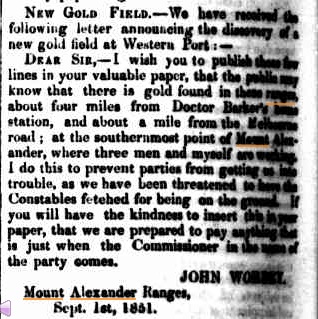
Original article in The Argus, 8th September, 1851.

John Worley, a bullock driver and Christopher Peters, a hut-keeper, both in the employ of William Barker, the owner of a pastoral run, made a discovery which would change the course of history in Victoria. It was a Sunday, so I suppose they had the day off and must have gone prospecting. Whatever reason brought them to the site, the two men found gold.

At first it was kept quiet. I guess Mr Barker didn’t want hordes of people rushing his land! Yet, John Worley sent a letter to the editor of the Argus in September, announcing the find . By October hundreds of diggers started to arrive and by December there were over 20,000 men working the fields at Mt Alexander (Castlemaine).

Other gold finds in Victoria are recorded before this date, but this was the first of great significance. Apparently in November there were three tons of gold in the Commissioner’s tent, waiting to be transported to Melbourne and thence to England. Imagine the excitement when ships carrying tons of gold arrived in England. A mass exodus! Our immigration boom began.

Gold was soon discovered in Ballarat and Bendigo as well, bringing thousands and thousands of people from around the world.

Imagine you were a simple farmer back in those days. Would you have dropped everything for a taste of gold, a chance at riches?

Published in: on 20th July, 2012 at 10:44 am  Comments (3)  
Tags: , , ,

On This Day …

14th July, 1770 (tomorrow)

‘Kangaroo’ George Stubbs (John Hawkesworth, An account of the Voyages undertaken by the order of His present Majesty, for making discoveries in the southern hemisphere, 1773)

The Endeavour had been badly damaged on the Great Barrier Reef and Captain Cook had to make a landing in order to repair his ship. So, he and the crew spent a couple of months on the North Queensland coast. This gave Joseph Banks, the resident botanist, plenty of time to study the local wildlife.

Imagine their surprise when they first encountered this large hopping beast. Perhaps they thought it was a giant rabbit. I’m sure they’d never seen anything like it before. I wonder, did they fear it? Did they think it beautiful?

It seems one of the crewman shot the kangaroo. Obviously this gave them opportunity to study it in more detail — including tasting its meat. They took some skin and bones home to England where artist George Stubbs created an image using these materials as a reference point. The image here is what he created and was inserted into An Account of the Voyages Undertaken by the Order of His Present Majesty, 1773.

And so this day is recorded as the first European sighting of the kangaroo, and its name was derived from an aboriginal word for the same.

Can you remember your first encounter with a kangaroo? What did you think?

Published in: on 13th July, 2012 at 10:34 am  Comments (4)  
Tags: ,

On This Day …

Tuesday 6th July, 1943

Photo by Simon Bayntun

It is not always remembered as strongly in the southern capitals of Australia, but during World War II, Darwin was attacked by Japanese air raids sixty-four times in total over about eighteen months. Today marks the last of the heavier raids. There were three more less significant raids at night during August, but the attacks were coming to an end.

I lived in the Darwin area for five years and there are reminders — memorials and markers — all over the place. The old air-strips used during the war run alongside the highway. Old cannons sit on the shoreline. Oil Storage Tunnels beneath the city still exist. You can’t miss the war memorabilia … unless you close your eyes.

I’m sure the people of Darwin will never forget that hundreds of men and women lost their lives, and even more were wounded, during those horrific bombings which were designed to cripple Australia’s defence force from assisting other areas of the Pacific under invasion.

It’s hard to imagine such a terrifying time, but chaos broke out in Darwin as half the population fled to the south. Even some of the RAAF servicemen deserted. Many of those who remained resorted to looting, leaving the city a shell of what she once was.

Evacuate or stay to protect what is yours? Which do you think you would do in such a situation?

Published in: on 6th July, 2012 at 12:05 pm  Leave a Comment  
Tags: , ,

On This Day …

15th June, 1862

Once again our bush rangers are in the news. It was a lazy Sunday in Forbes. Men and women drifted off to church, or those not so inclined probably imbibed several pints down at the local pub. Around midday, the Gold Escort left for its journey to Bathurst.

Around 3:30pm, the coach had to slow down to navigate a steep gully, five miles north of Eugowra. It was here that Frank Gardiner and his gang of disgruntled cattlemen waited in ambush behind a rock the aborigines called ‘Coonbong’, or dead man (now called Escort Rock).

At the shout of ‘bail up’ the driver and the troopers jumped down and ran for the bush. So it was that Frank Gardiner managed to make the largest gold robbery of Australia’s history. The gang made off with 2700 ounces in gold, valued in the millions today.

Sydney Empire news article, 24th June 1862.

The police only ever managed to recover half the gold. Frank Gardiner escaped to Queensland and eventually moved to San Fransisco. It is rumoured that two Californians came to Wheogo (Gardiner’s former property) in 1912, and posed as prospectors, were in fact, Gardiner’s sons, returning for the rest of their father’s gold. They left with their specimen bags full, so who knows?

If you were held up by a bush ranger, do you think you’d run like the men in this story, or stand your ground and fight for your property?


Published in: on 15th June, 2012 at 10:00 am  Comments (4)  
Tags: , ,

On This Day …

8th June, 1951

Education is an important part of life for our children. But imagine how hard it is for families who live on outback stations which can span thousands of square kilometres. It might be over one hundred kilometres to their nearest neighbour or town.

This isolation was first addressed by the Royal Flying Doctor Service, bringing medical attention to those in need via radio and aeroplane. In 1944 a council member of the RFDS, Adelaide Miethke, saw the need for children in those far away places to receive an education. And so the idea for School of the Air was born.

It took six years to put the equipment in place and a further year of testing before, on the 8th June, 1951, the School of the Air in Alice Springs was officially opened. Children could finally receive schooling lessons via two-way radio and communicate with their teachers.

The Alice Springs School of the Air still currently services approximately 130 students every year, covering a total area of over 1,000,000 square kilometres, although they are now able to use computers as well.

What a wonderful initiative Adelaide Miethke started. It only took one person who saw a need and did something about it.

If you lived in a remote area, what would you want your children to learn most of all?

Published in: on 8th June, 2012 at 10:00 am  Comments (6)  
Tags: , , ,

On This Day …

25th May, 1870

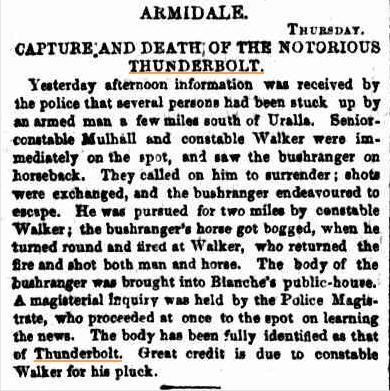
From the Sydney Morning Herald, 27th May 1870

One of Australia’s most notorious bushrangers, Captain Thunderbolt is dead. Shot down by Constable Alexander Binney Walker near Uralla after a long chase.

By the age of twenty, Frederick Ward had already begun a life of crime. Stealing horses was what he was first arrested and sentenced for. Following that, he added escape from gaol and went on to become the bushranger as he was known, with the alias Captain Thunderbolt. He most commonly robbed the mail coaches by hiding out behind Big Rock near Uralla, but his list of crimes also includes robbery of hotels, stores homes and even a toll-gate — seventy-seven crimes in all.

Although he was a thief, he must have been otherwise pleasant in character, for he was known as the gentleman bushranger. He was apparently polite, agreeable to look at, and he avoided violence where he could. He was an excellent horseman and only rode the best — or stole them as the case may be.  And there was romance in his life as well. He lived and rode with Mary Ann Bugg, a half-caste aboriginal, for many years, but they separated a few years before his death.

His life may have been short — he was only thirty-five when he died — but he is known as one of Australia’s most successful professional bushrangers.

Published in: on 25th May, 2012 at 3:02 pm  Comments (6)  
Tags: , ,